

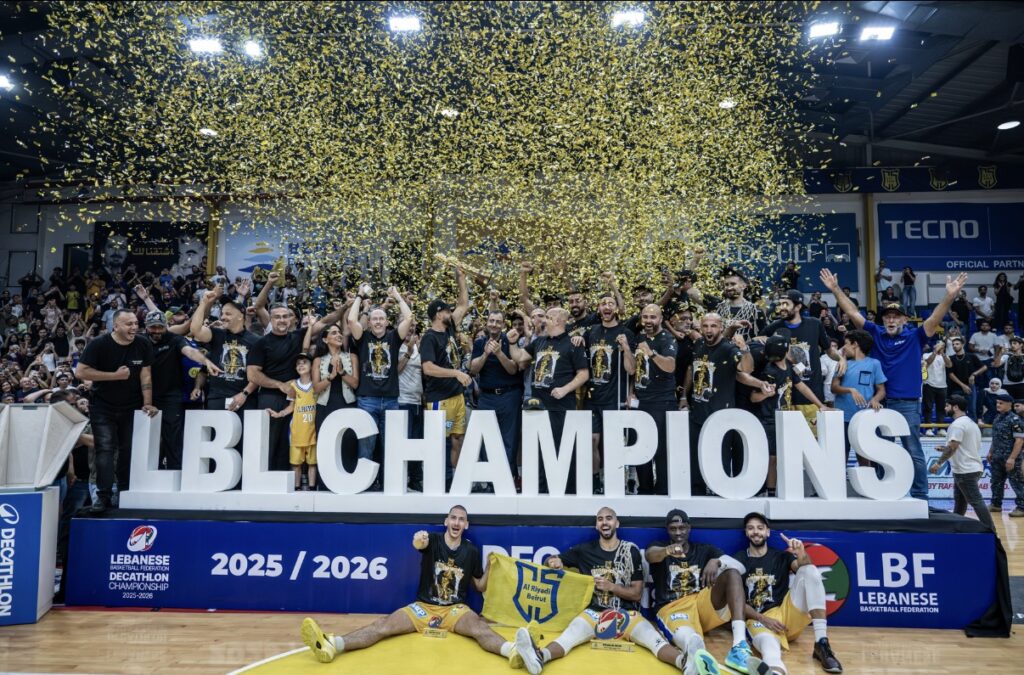
With the new Lebanese Basketball League season approaching, teams are finalizing their rosters, making important additions, and preparing for what promises to be another competitive campaign. Al Riyadi and Sagesse remain among the main contenders, while several clubs have undergone significant changes. Central could emerge as a dark horse, Antonine will look to build on last season’s progress, and Beirut Club is preparing for a new era under head coach Viktor Janketic.
Twelve teams are expected to participate in the 2026–27 Lebanese Basketball League, with the final spot still to be decided through the Division 2 promotion and barrage series. Here’s a closer look at each team’s preparations.
1. Sagesse Beirut: Building Around a Competitive Core
Sagesse enters the new season after losing the WASL Final 8 final against Al Riyadi Beirut. Despite the disappointing finish, the Green Castle has made several additions that could strengthen its chances of competing for the Lebanese championship.
Karim Ezzedine impressed during the WASL Final 8 following his return from injury, while Aziz Abdelmassih provided additional floor spacing and shooting. Deshawndre Washington also had a solid tournament, although AJ English and Jamal Jones struggled to make the expected impact.
Jones was replaced by Center Elijah Thomas adding FrontCourt depth to this Sagesse Team.
Youssef Khayat was another positive for Sagesse, showing improvement in his shooting before suffering an ankle injury. His availability and recovery will be important for the team moving forward.
Sagesse has also retained several familiar faces, including Ali Mezher, Roudy Hajj Moussa, Mark Khoueiry, Joe Abi Kherese and Gerard Hadidian.
With a mixture of returning players and new additions, Sagesse will hope to turn its continental experience into success domestically.
2. Al Riyadi Beirut: Champions Looking to Stay on Top
Fresh off winning the WASL Final 8, Al Riyadi Beirut will enter the new season looking to maintain its position at the top of Lebanese basketball.
One of the team’s main changes is the expected replacement of Zach Lofton with Perrin Buford, a familiar name to Al Riyadi supporters. The club also added Naim Rabay, who returns from Japan, and welcomed back club legend Ali Mahmoud.
Rabay provides another big who can stretch the floor, while Buford’s previous experience with the club could help him settle into the system.
Al Riyadi has retained much of its core, including Ali Mansour, Karim Zeinoun, Bilal Tabbara, Amir Saoud, Wael Arakji and Ismail Ahmad. However, Arakji’s situation remains a major concern after suffering ACL and MCL injuries, leaving his return timeline uncertain.
Donovan Williams was one of the standout performers during the WASL Final 8, giving the team another important offensive weapon. Veteran center Nick West has also joined the roster.
With considerable depth and experience, Al Riyadi will once again be among the favorites, although Arakji’s absence could influence the team’s plans.
3. Homenetmen Beirut: A New Beginning
Homenetmen has experienced one of the most significant overhauls ahead of the new season.
The club previously relied on Ali Haidar, Gabriel Salibi and Jean Mark Jarrouje as key pieces. However, major changes behind the scenes led to the departure of the previous management, followed by the exits of those players.
The team has since appointed head coach Ricky Cleveland and begun assembling a new roster.
Among the local additions are Jimmy Nakhle, Karim Oueidat, Peter Dekermejian, Omar Younes, Raphael Jouljian, Joseph Khoury and Carl Zaloum.
Homenetmen has also recruited three imports: Mervin James, Chauncey Collins and Derek Culver.
The challenge will be bringing these new pieces together quickly. With so many changes, chemistry and consistency will be crucial if Homenetmen hopes to compete against the league’s established contenders.
4. Beirut Club: A Young Team Under New Leadership
Beirut Club is entering a rebuilding phase, with head coach Viktor Janketic leading a younger roster.
The club has recruited Anthony Naba, Hadi El Khatib, Miguel Martinez, Fadi Mougharbel, Steve Assaf, Abd Sabbagh and Omar El Tabash as it looks to establish a new identity.
Its original import lineup included Deng Acuoth, Marcus Thornton and Michael Frazier II. However, Frazier suffered an injury during practice and is set to be replaced by Darlinstone Dubar for the Arab Club Basketball Championship.
The new roster represents a different direction for Beirut Club, which will need its local players and imports to adapt quickly.
After facing Al Riyadi in the playoffs last season, the club will be hoping its rebuilding process produces a competitive team capable of challenging the league’s stronger sides.
5. Antonine: Looking to Build on Last Season’s Progress
Antonine emerged as one of the most interesting teams last season, and the club will be hoping to continue that progress in 2026–27.
The team has retained key local players Elie Chamoun and Anthony Assi while adding several important pieces.
Joe Abou Samra and Omar El Jamal bring promising young talent, while experienced forward Jimmy Salem joins following his latest stint in Japan. Antonine has also retained Ghassan Abou Tacca and recruited John Kairouz, a Lebanese-origin player coming from the United States who will count as a local.
On the import front, the club signed Julian Gambrell, Dikembe Dixon and Justin Patton. However, Patton suffered a season-ending injury and is getting replaced by Center Player Brandon Huntley Hatfield (23YO 208CMS).
Antonine’s ability to maintain its chemistry while integrating the new arrivals will be a major factor in determining how far the team can go.
After demonstrating that it can compete with the league’s established powers, Antonine will aim to take another step forward this season.
6. Central Club: The Potential Dark Horse
Central could be one of the most intriguing teams to watch this season after making several additions to an already competitive roster.
The club recruited Omar Jamaleddine and Jad Khalil from Sagesse and brought back Elie Ghaleb, also from Sagesse. Chris El Hachem arrives from NSA, adding further depth to the local rotation.
Central has worked to preserve the core built under head coach Georges Geagea, retaining Jihad El Khatib, Matthew Khoury and Elios Saad.
The club also retained Anyеuri Castillo and added Desi Washington, who arrives from Batroun Club, alongside Jarvis Williams, who previously played for Al Riyadi.
The combination of returning players, local additions and experienced imports could make Central a difficult matchup for any opponent.
Central has shown signs of its potential, and if the new arrivals fit into Geagea’s system, the club could emerge as a genuine dark horse in the upcoming campaign.
7. NSA Club: Experience Meets a New Import Rotation
NSA Club has continued building its roster around a familiar local core while adding several experienced players.
Georges Yves Daaboul and Ali Haidar are among the club’s notable additions. NSA has also retained Christophe Khalil, Karam Mechref and Mike Haddad.
The team initially signed Gabriel Samaha and Andrew Kopali, but both contracts were subsequently terminated by mutual agreement.
NSA’s current import lineup consists of Chol Marial, George Marshall and Jonathan Lawson, with Marwan Khalil leading the team from the sidelines.
The club will need consistency from its imports and reliable contributions from its returning local players to compete with the league’s stronger teams.
With its roster still taking shape, NSA’s final chemistry and performances will determine whether it can become a serious contender for a playoff spot.
8. Antranik Beirut: Maintaining Continuity
Antranik has opted to preserve much of its local core while making targeted additions to strengthen the roster.
The club lost Gabriel Salibi in free agency but brought back Youssef Ghantous and recruited Jean-Luc Makhlouf. It has also retained Alaa Sabbagh, Guy Rizk and Kevork Kevork.
Antranik’s import trio consists of Lok Wur, Devin Story and Armond Davis, with Elie Merheb continuing as head coach.
Maintaining continuity could prove valuable in a league where several teams have undergone significant changes.
Antranik will look to build on its existing chemistry and establish itself as a competitive side capable of challenging teams with bigger budgets and deeper rosters.
9. Hoops Club: A New-Look Import Trio
Hoops Club will enter the new season under head coach Gilbert Nasr, with the team relying on a combination of returning local players and three new imports.
The club’s import lineup includes Brandon Randolph, Mamadou Diarra and Keenon Cole.
Hoops has retained several local players, including Hisham El Helou, Rayan Hachem, Antonio Habib, Johnny Sawma, Zein Makhzoum, Abbas Atwi, Ahmad Akkawi and Habib Abdallah.
The team’s prospects will depend heavily on how quickly the imports adapt to Lebanese basketball and how effectively they integrate with the local rotation.
With a relatively stable group of domestic players, Hoops will hope to establish consistency and compete for a place in the playoffs.
10. Batroun Club: Waiting for the Pieces to Fall Into Place
Batroun has been slower to build its roster after facing difficulties securing its budget for the upcoming season.
Head coach Charbel Feghaly will lead the team’s preparations as the club looks to put together a competitive lineup.
Batroun is reportedly negotiating with Bob Haddad, Luay Salha and Karl Kozah, while also exploring the possibility of retaining some players from last season.
Much remains uncertain about the final roster, particularly the import positions.
Batroun’s ability to resolve its financial and recruitment issues will be crucial. If the club can retain important pieces and make the right additions, it could put together a competitive team despite its delayed preparations.
11. Atlas: Back in Division 1
Atlas will take the 11th spot in the 2026–27 Lebanese Basketball League, returning to the top division as the club prepares to compete against Lebanon’s established teams.
The challenge will be adapting to the higher level of competition and assembling a roster capable of remaining competitive throughout the season.
12. Tadamon Hrajel
Tadamon Hrajel will remain in the Lebanese Basketball League’s Division 1 for the 2026–27 season following the withdrawal of Leaders Champs from the barrage series. The development secures Tadamon’s place in the top division, while the club prepares for a new chapter under fresh management.
The club will undergo a major transformation, adopting a new name and identity: CTD Ultimate Performer.
The new management has appointed George Khoury as head coach, with the Lebanese coach already beginning work on assembling the team’s roster ahead of the upcoming season.
With preparations now underway, Khoury’s first task will be to build a competitive squad capable of establishing itself in Division 1. The club’s recruitment strategy and choice of imports will be crucial as it looks to compete against Lebanon’s established teams.
The change in management and identity marks a new beginning for the Hrajel-based club, which will aim to approach the upcoming campaign with renewed ambitions.
The league will feature 12 teams, with Atlas taking the 11th spot and the winner of the Leaders Champs–Tadamon Hrajel barrage claiming the 12th and final place.
A Competitive Season Ahead
The 2026–27 Lebanese Basketball League is shaping up to be an interesting campaign, with Al Riyadi looking to defend its position, Sagesse aiming to bounce back, and Central and Antonine hoping to challenge the established order.
Meanwhile, Homenetmen and Beirut Club are entering new phases, while several other teams are working to find the right balance between local talent and imports.
With roster changes still underway and the final Division 1 spot yet to be decided, the picture is not complete. The coming weeks should provide a clearer idea of which teams are best positioned to compete for the championship and which could surprise the league.
Roster note: Several signings, import replacements and negotiations mentioned above remain subject to confirmation. Wael Arakji’s return timeline is still an important development to monitor.